Operational update May 2016
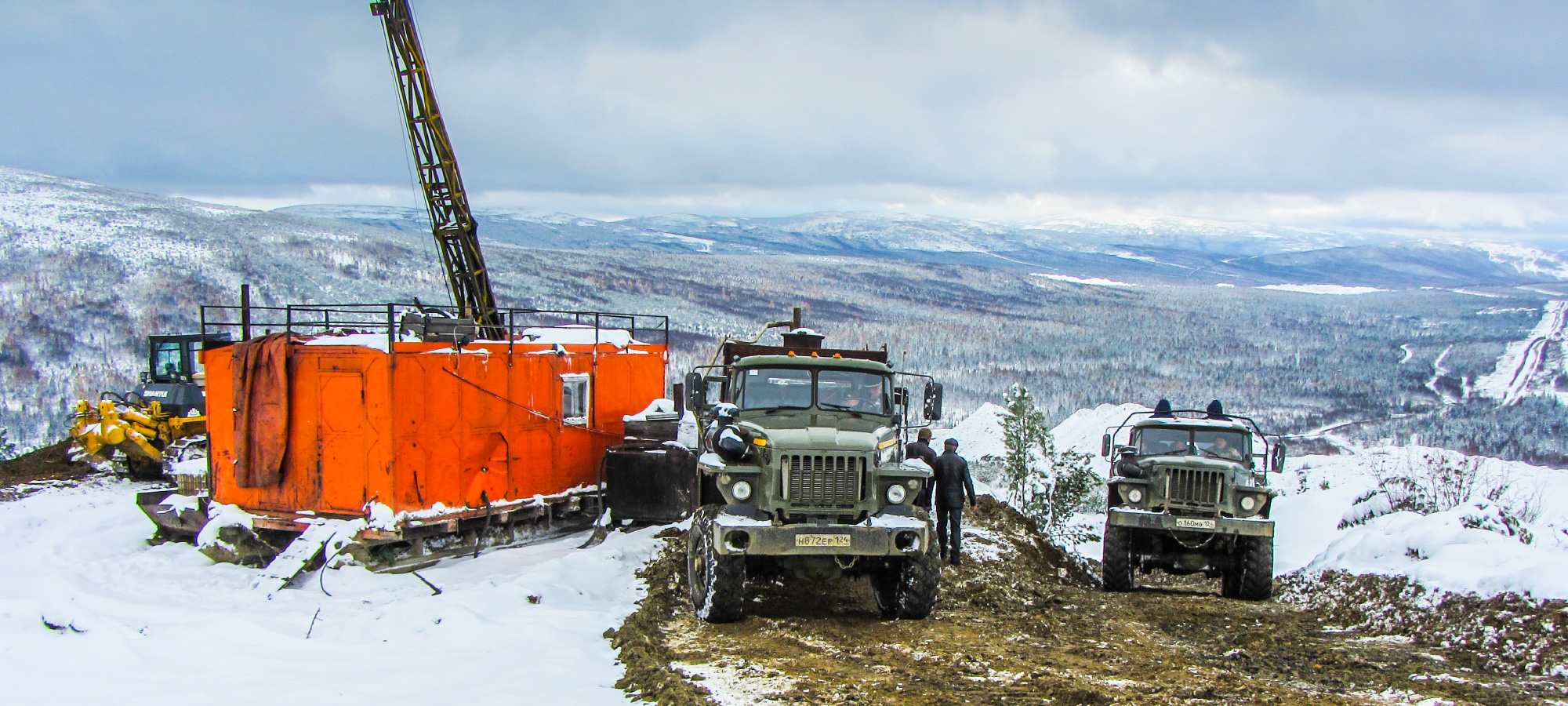
Kopy Goldfields AB (publ) (“Kopy Goldfields” or the “Company”) hereby provides an update of the Company’s operations:
Continue reading “Operational update May 2016”
Kommuniké från årsstämma i Kopy Goldfields
Årsstämma med aktieägarna i Kopy Goldfields AB (publ) har hållits i Stockholm den 26 maj 2016. Ordförande för stämman var Johan Österling.
Continue reading “Kommuniké från årsstämma i Kopy Goldfields”
Krasny project JORC resources update: 955 000 oz of gold at 1,200 USD/oz gold price
Krasny project JORC resources update: 955 000 oz of gold at 1,200 USD/oz gold price Kopy Goldfields AB (publ) (“Kopy Goldfields” or the “Company”) is happy to announce an updated JORC mineral resource estimate for the Krasny deposit. The updated estimate is issued by Micon International Co Limited (“Micon”) and shows 288,000 oz of Indicated mineral resources (7,848,000 tons of rock at an average grade of 1.141 g/t Au) and 667,000 oz of Inferred mineral resources (12,324,000 tons at an average grade of 1.682 g/t Au) within an economically minable open pit. The current resource estimation increases the quality of gold resources and Indicated resources now represent 30% of the total mineral resources reported, compared to 15% in the previous JORC report from 2013. The current estimation does not include the recent drill results acquired since January 2016.
The mineral resource estimate was done by Michael Khoudine, M.Sc senior mining engineer for Micon using a resource block model created by Evgeny Kondratiev, M.Sc., MAusIMM (CP), senior exploration geologist for Micon. This estimate was prepared by Micon in accordance with the JORC Code for reporting of Mineral Resources (see Table 1 and Appendix 1 for details).
Table 1. Mineral Resource Statement for the Krasny Gold Deposit, Irkutsk Region, Russia, Micon International, May 23, 2016*
| Category | Ore (kt) | Au grade (g/t) | Au (kg) | Au (koz) |
| Indicated | 7 848 | 1,141 | 8 958 | 288 |
| Inferred | 12 324 | 1,682 | 20 732 | 667 |
*Notes:
- Mineral Resources are not Mineral Reserves and do not have demonstrated economic viability. There is no certainty that all or any part of the Mineral Resources estimated will be converted into Mineral Reserves estimate;
- Resources stated as contained within a potentially economically minable open pit stated above a 0.4g/t Au cut-off for the oxide ore and above 0.3g/t Au cut-off for the primary ore;
- Pit optimization is based on an assumed gold price of $1,200/oz, metallurgical recovery of 90% for primary ore and 79% for oxide ore. Used cost values are $2.36/m3 for waste mining, $1.10/t for ore mining and a processing and G&A cost is $7.95/t;
- Mineral resource tonnage and contained metal have been rounded to reflect the accuracy of the estimate, and numbers may not add due to rounding;
- Mineral resource tonnage and grade are reported as diluted to reflect a potentially minable bench height of 10 m.
As a follow-up to this press release, a detailed JORC-compliant Technical Memorandum on Resources will be prepared by Micon for the Krasny deposit and published on the Company’s website.
This mineral resource estimate is an update of the previous JORC resource estimate of the Krasny deposit that was released on March 26, 2013. Since then, an intense exploration program (Stage 1 and Stage 2) developed by the Company in cooperation with GV Gold during 2014-2015. While the previous resource estimate was based on 15,297 meters of core drilling, 1,362 meters of trench sampling and one mineral processing test; the current estimate is the result of totally 31,195 meters of core drilling, 2,822 meters of trench sampling and 4 mineral processing tests. During the 2015 mineral processing test, it was discovered that the Krasny deposit has two types of ore – oxidized and primary – with different gold recovery ratios, which is now reflected in the new resource estimation. In addition, the previous resource estimate was based on an assumption of a gold price of 1,670 USD/oz, while the current estimate is based on the market price of 1,200 USD/oz.
Earlier this year, Kopy Goldfields also reported mineral resources and reserves in accordance with the Russian GKZ reporting provisions (“GKZ report”) of total ore reserves under the C2 category of 6,317 ktons with an average grade of 1.55 gr/t, that makes 9,767 kg of gold (314 koz). This GKZ report was developed on the exploration data acquired before January 1, 2015 (not including 7,551 meters of core drilling during 2015) and was limited to the Central Upper part of Krasny mineralization. JORC and GKZ reports, although using similar basic geological principals of resource calculation, are drafted under different framework and reporting procedures and therefore usually provide different estimations of resources and particularly reserves, which in turn means that the outcome from the JORC report will not necessarily be the same as from the GKZ report.
Mikhail Damrin, CEO of Kopy Goldfields, commented the results: “We are very pleased with the results reported by Micon as they are in line with our own internal modelling of Krasny. We have always believed that the Lower structure would be minable despite the decrease in gold prices since 2013 and we are now glad to receive another confirmation for that. Although the new estimate shows a total amount of gold resources somewhat lower than the previous one reported in 2013, it is based on more drilling data and reflects the current market conditions that make it more reliable and robust. The new estimate shows increase in quality of gold resources with a higher ratio of Indicated resources than before. Tested by a 30% fall in gold prices since 2013, Krasny proved to be a solid 1 Moz gold deposit and we still see a lot of potential to further resource increase along the strike, to the depth and within parallel mineralized structures, all within the Krasny license boundaries”.
Evgeny Kondratiev of Micon, commented the Krasny resource report: “The quality of the exploration work done on the Krasny project in general follows both Russian and JORC recommendations on QA/QC. We did not reported Measured Resources for Krasny at the current stage for the same reason that we do not usually report Measured gold resources at the exploration stage. This category requires a high level of confidence in, and understanding of, the geological properties and controls of the mineral deposit. Gold mineralization as a rule (and Krasny fills in) has un-uniform gold grade distribution and variable thickness of ore bodies, so the geological and grade continuity of mineralized zones cannot be confidently interpreted. Although we report resources within the minable open pit and we believe that Krasny resources are potentially minable, we cannot report them as Reserves because Ore Reserves can be defined only by studies at Pre-Feasibility or Feasibility level. It is our further task during which additional research on the mineral processing parameters, geotechnical and hydrogeological characteristics is required. We understand that the coming exploration program on Krasny is going to address most of them. Overall, we have a positive view on the Krasny project development and we believe that the project has all possibilities to be taken into production.”
For the complete press release including tables, images and maps see attached document.
För pressmeddelande på svenska se bifogat dokument (Swedish).
Stockholm, May 26, 2016
For more information, please contact:
Mikhail Damrin, CEO, +7 916 808 12 17, mikhail.damrin@kopygoldfields.com
Tim Carlsson, CFO, + 46 702 31 87 01, tim.carlsson@kopygoldfields.com
About Kopy Goldfields AB
Kopy Goldfields AB (publ), listed at NASDAQ First North in Stockholm is a gold exploration and production company operating in one of the most gold rich areas in the world; Lena Goldfields, Bodaibo, Russia. The company holds 11 bedrock exploration- and production licenses and one alluvial license covering in total 1,963 sq km, of which the Krasny licenses (bedrock and alluvial) are held 49% by the company. The preliminary forecast is to be in production in 2018. The target for Kopy Goldfields is to become a near-term gold producer in cooperation with a producing partner under JV agreement.
Kopy Goldfields AB applies International Financial Reporting Standards (IFRS), as approved by the European Union. Aqurat Fondkommission acts as Certified Adviser, contact number: +46-8-684 05 800.
The Share
Ticker: KOPY
http://www.nasdaqomxnordic.com/shares/microsite?Instrument=SSE77457
Outstanding shares: 59,899,541
Krasny project – new positive scoping study results for the upper structure
Kopy Goldfields AB (publ) (“Kopy Goldfields” or the “Company”) is happy to announce positive scoping study results for the Krasny gold project. The study evaluated gold production from the Upper structure only and confirmed feasibility of Krasny mine development with total undiscounted free cash flow of USD 94 million at a fixed gold price of 1,100 USD/oz and estimated total production costs of 475 USD/oz.
The scoping study was performed by Irgiredmet engineering consultancy during January – March 2016 and included all exploration results until and including Stage 2 of the recently finalized exploration program. The study evaluated financial results of gold production from the Upper structure only and did not include any development of the Lower structure thus leaving the upside from gold production of the Lower structure for the future. The scoping study confirmed the feasibility of mine development based on the Upper gold structure only and was used as an external justification for moving the Upper gold structure into Feasibility Studies.
The scoping study was done in parallel with the GKZ-reporting and the JORC-reporting which means that the amount of gold mined in the scoping study is based on an internal calculation rather than the approved GKZ-reserves or the coming JORC-report. Compared to the scoping study released in April 2013, this study is based on only the Upper mineralization and a fixed gold price of 1,100 USD/oz is used instead of 1,670 USD/oz.
Highlights of the scoping study:
- Total gold resources mined: 5,927 ktons
- Average grade: 1.75 g/t
- Total gold mined: 10,351 kg of gold (332 koz)
- Mine and plant capacity: 800 ktons of rock per annum
- Overall recovery: 78%
- Life of mine: 8 years
- Total gold produced: 8,075 kg (260 koz)
- Average annual gold production, LOM: 1,009 kg (32 koz)
- Average gold price: 1,100 USD/oz at fixed Rub/USD rate of 70
- Annual average revenue from gold sales: USD 35 million
- Annual average profit before tax: USD 15 million
- Initial capital costs (no VAT): USD 49 million (plant, open pit, infrastructure, equipment and machinery)
- Total capital costs (incl. resale of equipment and land reclamation, Rub/USD rate of 70): USD 38 million
- Total production costs (mining, processing, royalty and admin): 475 USD/oz
- Undiscounted project value: USD 94 million (USD 119 million pretax)
- Discounted project value (NPV): USD 25 million at 10% discount rate
- IRR: 18%
- Average strip ratio: 2.84 m3/t
The scoping study does not discuss financing options for project development. Financing of the mine and plant will be discussed later this year when the results from Feasibility Studies and the 2016 explorations activities of the Lower structure will be summarized. However, there is a general understanding between the Company and GV Gold that majority of financing should be raised by debt.
Mikhail Damrin, CEO of Kopy Goldfields, commented the results: “We are pleased with the results of the scoping study. There have been several valuations of the Krasny gold production done internally already and there will be many more valuations in the future, however all studies confirm feasibility of mine development on Krasny. The target of this study was to get an external verification of future production and capital costs before commencing the 2016 development program. The results of the study confirm that the Krasny project is profitable even if the mine development is limited to the Upper structure only. We believe that the Lower structure is minable as well at the current conditions and following the 2016 explorations we will update the valuation by adding production from the Lower structure as well. We have now moved into feasibility activities for the Upper structure and further exploration activities for the Lower structure with confidence”.
För pressmeddelande på svenska se bifogat dokument (Swedish).
Stockholm, May 12, 2016
For more information, please contact:
Mikhail Damrin, CEO, +7 916 808 12 17, mikhail.damrin@kopygoldfields.com
Tim Carlsson, CFO, + 46 702 31 87 01, tim.carlsson@kopygoldfields.com
About Kopy Goldfields AB
Kopy Goldfields AB (publ), listed at NASDAQ First North in Stockholm is a gold exploration and production company operating in one of the most gold rich areas in the world; Lena Goldfields, Bodaibo, Russia. The company holds 11 bedrock exploration- and production licenses and one alluvial license covering in total 1,963 sq km, of which the Krasny licenses (bedrock and alluvial) are held 49% by the company. The preliminary forecast is to be in production in 2018. The target for Kopy Goldfields is to become a near-term gold producer in cooperation with a producing partner under JV agreement.
Kopy Goldfields AB applies International Financial Reporting Standards (IFRS), as approved by the European Union. Aqurat Fondkommission acts as Certified Adviser, contact number: +46-8-684 05 800.
The Share
Ticker: KOPY
http://www.nasdaqomxnordic.com/shares/microsite?Instrument=SSE77457
Outstanding shares: 59,899,541
Evaluate Your Product
There are a lot of startups out there creating great product design. But how are you supposed to evaluate innovation?
John Long at The Ship’s Log has 3 simple questions (and sub-questions) to ask when considering your product.
Is it Usable?
And now for the sub-questions!
Is the heart of the application easy to use?
Are the entry points (landing pages, signup, etc.) straightforward?
Will the average customer understand how to get started?
Is the copy used in your application helpful, instructive, and intuitive?
What are the common pitfalls? How can you design the application so that those are never experienced?
Is it Credible?
Credibility isn’t necessarily the VeriSign certificate—think polish. Does your product have the credibility that makes someone want to use your application because of the way it looks and feels?
“Credibility is about dressing to impress. If the custom fitted suit and gold watch don’t impress your clients and help you become a real, viable business then you’ll have spent valuable time and money creating something with no value.”
Is it Easy to Change?
No product design is perfect; expect to get some customer feedback and need to make spur-of-the-moment changes. Look out for:
Cramming too many functions into one screen.
Using technology in key places that is not well supported by the majority of browsers.
Trying to achieve desktop-caliber controls.
Making features Javascript-heavy that could be pure HTML.
Using an excessive number of images (pure HTML is much easier to maintain).
[From labs.openviewpartners.com]
Stages of the startup lifecycle
Birth, growth, reproduction, and death. In the same way as humans go through life stages, startups go through phases that entrepreneurs should be aware of in order to effectively guide their projects.
Max Marmer, founder of Startup Genome, presents six. It seems essential to know how to face each of them so the startup survives:
Discovery
Your first task as an entrepreneur is to consider how you would like to change the world. Identify a problem, come up with a solution and see if anyone – especially potential users and clients – might be interested in your idea.
Beyond the possibility of getting accepted in a startup accelerator and gathering funds from family and friends, this first phase requires developing the minimum viable product (MVP) that will enable surveying the market and getting a sense of the project’s acceptance.
This is what Dropbox did at the beginning. The cloud storage website published a video explaining its service using an MVP and, furthermore, the appearance it would have. This video was one of the strategies that enabled the company to reach 75,000 users whilst in beta form.
Validation
A startup’s service or products go from being hypothetical solutions to a problem to hitting the street and looking for the first clients ready to pay for it. At this stage, money will be the only way to effectively measure whether the public validates your project.
This is precisely what growing numbers of technological companies do when starting crowdfunding campaigns.
Pebble, the record-breaking smartwatch, managed to raise $10million in Kickstarter. This is an impressive example of crowdfunding validation. People wanted a smartwatch, and they were willing to pay for it in advance.
Efficiency
In order to successfully overcome this third phase, the best allies will be market studies and, more than ever, the advice of a good investor. Listen to the voice of experience.
At this point, the entrepreneur has to analyse characteristics and variables of everything that surrounds the startup (market, clients, etc.) in order to find the business model that adjusts best to the environment.The aim is to increase the customer base in the most effective way possible, preventing growth from stifling the project.
Scale
It is time to prove the business’s scalability – its capacity to grow in a sustainable manner (keeping costs down). The startup has to be ready to fight in international markets and offer great margins of benefit. It is time to step on the gas and push the growth aggressively – it is time for the larger fundraising rounds.
That is how Airbnb and the controversial Uber have managed to grow to the point of being present in countless corners globally. A couple of fundraising rounds of over $1billion in the first case, and around $0.5billion in the second, show how these are good examples of internationalisation..
Maintenance
Once the step has been taken to reach other markets with support of large fundraising rounds, it is time to shore up the project’s bases so the structure that youhave put so much effort into building does not collapse.
Maximising benefits and facing problems derived from the global dimension that the startup has acquired are key in this phase. The greatest risk is taking for granted that, having reached certain success, everything is done. Don’t stand by to admire your product; there are problems that can put the longevity of your business project at risk.
Sale or renewal
Your business model works, or is at least credible. You have the funding needed to internationalise the company, and you have carried it out successfully. Now what? Experience tells us that there are two ways: to sell the startup to a giant (Google, Facebook, Apple…) or to go public and try becoming one of the ‘unicorns’.
Only in this way you can acquire the huge resources that the brand will need to continue growing, renewing its products, and reinventing itself constantly in order to confront a dynamic market.
[From unconvention.eu]
What make a brand successful?
With the volume of competition that businesses face in most industries, it’s never been more important to stand out and develop a unique identity and value proposition through strategic branding. While it’s obviously important to offer a quality product or service, effective branding is often at the heart of the companies that thrive.
According to Jerry McLaughlin, “brand is the perception someone holds in their head about you, a product, a service, an organization, a cause, or an idea. Brand building is the deliberate and skillful application of effort to create a desired perception in someone else’s mind.” Let’s explore the common characteristics of successful brands, so you can build your brand accordingly.
1. Audience Knowledge
The best brands have a thorough understanding of the demographics of their target market, what their interests are, and how they communicate. Unless it’s a mega chain like Wal-Mart, most businesses have a specific target audience they’re pursuing. Understanding the target market is critical because it provides direction for the tone and reach of a marketing campaign, along with the overall identity of a brand, while helping to create an organic, human connection between a business and its audience.
Trying to appeal to everyone (ie, ignoring the concept of a target market) can be counterproductive, causing a company’s brand to become diluted. Finding the right branding approach requires first understanding the target market.
2. Uniqueness
Establishing a brand identity requires something distinctive. For instance, Apple has become known worldwide for their innovative products and minimalistic, aesthetic appeal. When it comes to service companies, Domino’s Pizza used to guarantee that their pizza would arrive in 30 minutes or it’d be free. In terms of a selling point, TOMS shoes donates a free pair of shoes to a child in need for every pair of shoes that are bought.
Creating an identity within a niche doesn’t demand a revolutionary idea. It simply needs to have one special thing that separates it from the competition. In reality, it’s possible to be “a one trick pony” as long as that trick is really good. Once a company figures out what that is, it can concentrate on it and should gain recognition in time.
Do you know what your unique product, service, or selling point is within your niche? If not, start there when building your branding strategy.
3. Passion
While it’s certainly possible to build a brand in the short-term without passion, it’s almost impossible to sustain it in the long run. When you examine massively successful people like Steve Jobs, they all have a serious passion that keeps propelling them to work hard and continually deliver greatness. That passion leads to enthusiasm and genuine joy, which is infectious.
Consumers often become just as enthusiastic about a product or service, leading to word of mouth advertising and referrals. Passion also helps businesses persevere through inevitable setbacks.
4. Consistency
When consumers come back to a business for repeat sales, they usually expect to receive the same level of quality as they did the first time. Restaurants and their food and service quality are a great example of this.
No one wants to deal with a company they can’t rely on for consistency. With so many industries being saturated with competitors, inconsistency is often enough of a reason for consumers to take their business elsewhere.
[From forbes.com]
New design trends
Who can forget the GIFs of the ‘90s, or the more up-to-date focus on flat design?
Recently, we’ve seen a surge in popularity of responsive web design, as more and more sites join the drive to become ‘mobile ready’ which is now even more important in the wake of Google’s Mobile Friendly update.
Let’s examine some of the most popular for this and the coming year.
1. The Proliferation of UI Patterns
2. Rich Animations
3. Microinteractions
4. Material Design: A Richer Alternative to Flat Design
5. Responsive Design
6. Flat Isn’t Going Away Anytime Soon
Additional Advice on Web Design Trends
Don’t follow trends just because they’re the “hip” thing to do at the moment. Trends represent popular techniques for good reason, but make sure it’s best for your users. For example, an e-commerce site certainly wouldn’t do well as a single-page infinite scrolling site.
Trends are nothing more than additional tools in your designer toolbox. Always pick the right ones for the job.
For more advice on the 10 most important web design trends, check out the free e-book Web Design Trends 2015 and 2016. You’ll learn from the best with analysis of 166 examples from companies like Google, Apple, Reebok, BMW, Intercom, Adidas, Dropbox, and many more.
[From awwwards.com]
Daily Inspiration
On autumn weekends with good weather you can almost experience caravans of people marching over the grandiose lookout balconies between the Dolomites and the Tauern and filling the mountain lodges to capacity. But very few people have the idea of turning the perspective around and approaching the Carnic ridge for once from the valley side. And that is something that is certainly worthwhile.
It is no coincidence that at Heinfels in the valley of Drau, which is called Pustertal here, there stands an ancient castle that still appears to be fortified. It guards the entrance to two valleys: the Villgratental and the Tyrolean Gailtal. The latter is quite hidden, as it begins with a terrain level high above the valley floor of the river Drau.
There is a climb of several hundred metres on a serpentine road before reaching the community of Kartitsch, with the prettily shaped tower of the St. Leonhard parish church. From the enclosure wall of the cemetery you can enjoy a distant view to the west into the Pustertal, which here runs in a strikingly straight line. The reason for this is a distinct geological line, the “peri-adriatic seam“. This frontier line leaves the Pustertal in Kartitsch and follows the Tyrolean Gailtal, which to the east of the Kartitscher Sattel is called the Tilliacher Tal, and then further east beyond the federal border with Carinthia again changes its name, and for the next 20 kilometres goes under the name of Lesachtal. At Kötschach-Mauthen the name of the valley changes again, confusingly back to Gailtal, which at Villach at last flows into the Drau.
Viewed from above, the Gail or Lesachtal also runs in a straight line. There is a clear distinction in appearance between the northern and southern sides of the valley. N ons side the gentle foothills of the Lienzer Dolomites, with its wide alp areas, on the other side the rocky contours of the Carnic ridge towering above thick mountain forest and marking the state border with Italy.
In Kartitsch we are already 1.350 m above sea level, the area is one of the highest situated valleys in East Tyrol, which itself is at high altitude.
Some 200 m higher the Kartitscher Sattel is reached, from where you can look down onto Obertilliach and Untertilliach.
“Golzentipp“ is the name of the local mountain in this area. A perfect vantage point with a grandiose panorama view, encompassing the Hohen Tauern and the Schober group of mountains, the Lienzer Dolomites, the Carnic Alps, the Sextener Dolomites and far into the Pustertal. The chances are good that the view can also be enjoyed, as testified by the many years of meteorological records taken in this region, showing an above-average number of sunny days.
Fans of high rocky cliffs will prefer the south side of the valley and head for one of the many side valleys of the Carnic ridge. Pfannspitze, Großer Kinigat, Porze, Cima Manzon, Gamskofel, Hochspitz, Steinkarspitz – between the Obstanser See and the Luggauer Scharte there are countless opportunities to test your stamina and alpine abilities in the midst of grandiose mountain scenery.
[From mountainvillages.at]